
The Best CPU Coolers in 2024
When you’re building PC, it is easy to only focus on raw power for your CPU and GPU. To keep those powerful components functioning efficiently though, you need the best CPU cooler. Coolers are vital for the health of your system and while they aren’t as exciting as a graphics card, they’re one of the most important aspects of your set-up.
You have a lot of options when it comes to a CPU cooler though. You need a unit that is going to really take good care of your gaming CPU, so you need to be careful in your purchase. Even picking between air cooling and liquid cooling is a big decision.
On top of that, you have to consider how they interact with your components, different CPUs tend to run at different temperatures, making different cooling needs a necessity. Then there’s efficiency, ease of installation, and even how many flashing RGB lights you can fit into it.
These are some of the best CPU coolers for gaming out there. Among them, there is one to suit any type of PC and any user.
Best CPU Coolers
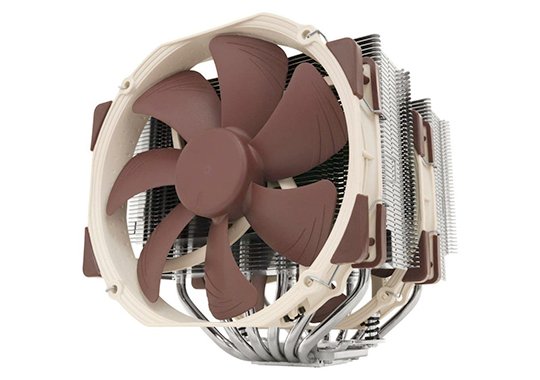
Noctua NH-D15
The Best Air CPU Cooler
- Quiet
- 2 Fans
- Dual Tower Design
The Noctua NH-D15 is a really solid CPU cooler. This is an air CPU cooler, and it is a powerful companion to your case fans. This can run at a really low volume, keep even overclocked CPUs cool, and even outperform liquid coolers in the right circumstances.
The D15 can work really effectively when it is utilized properly. It has a dual-tower heatsink and two high airflow fans. This means it can cool considerably quicker and can compensate for even the hottest CPUs, great news for overclockers.
There is a drawback of all of those qualities… the price. This is a high-end cooler and it shows, it can also be a little bulky. However, since this can rival liquid cooling systems you’re getting pretty good value still.
- Low Volume for an Air Cooler
- 6 Year Warranty
- Optimized Fans with Adaptors for Ultra-Quiet Operation
- More Expensive
- Bulky
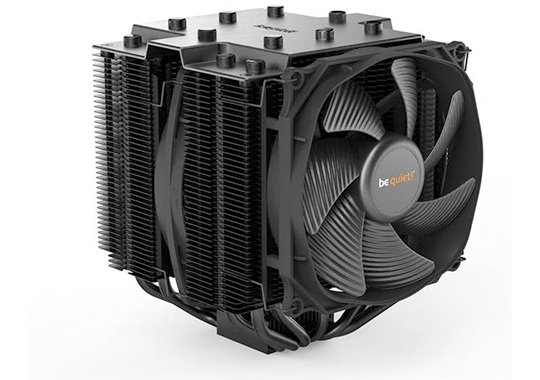
Be Quiet! Dark Rock Pro 4
Quiet Air CPU Cooler
- Two Wings PWM Fans
- Funnel Shape Design for Better Air Pressure
- 7 Copper Heat Pipes
The Be Quiet! Dark Rock Pro is built to run as quietly as possible, but it doesn’t sacrifice performance. This fan can be run at a nearly unnoticeable noise.
The device can cool things efficiently despite being quiet. It features two airflow optimized fans. This can help it cool the vast majority of CPUs effectively.
It is compatible with both Intel and AMD CPUs. With its high efficiency and volume, it is perfect for use in a demanding CPUs.
If you’re looking for ease of use, the Dark Rock Pro is also quite useful. It has an installation kit for easy mounting from above. This takes some of the stress out of building a well-functioning PC if you’re a beginner.
This is definitely one of the best CPU coolers for keeping noise to a minimum, but it doesn’t underperform to accomplish this.
- Very Quiet For an Air Cooler
- Easy to Install and Use
- Good Performance
- Not as Effective as Others
- Quite Big
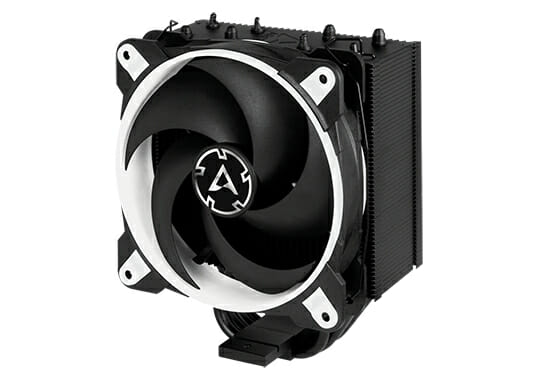
Arctic Freezer 34 eSports
The Budget Legend
- 4 heatsink pipes
- Fin Material: Aluminum
- BioniX-P fan
When looking at budget options for CPU coolers you would probably not expect it to be exceptionally good, but what if we told you there is a budget option that can even cool Threadripper CPUs?
The Arctic Freezer 34 eSports is a great budget air cooler that uses a solid heatsink and an Arctic BioniX-P fan for great cooling performance and solid acoustics. This particular CPU cooler has 4 heat pipes (which is not exactly impressive) and the fins on the heatsink are made out of aluminum.
Although we don’t see copper pipes or higher grade materials it seems that even with what it has, the Arctic Freezer CPU cooler is extremely good at what it does for a very decent price. The fan speed on the BioniX-P fan goes from 200-2000 RPM which ensures enough air goes through your CPU heatsink.
The installation of the CPU cooler is straightforward with no unnecessary troubles making this a 5-minute job for a CPU cooler swap.
Overall the Arctic Freezer 34 eSports is currently the best budget option that performs extremely well (close to the Noctua NH-U12S) for a fraction of the more expensive competitors (it also goes on sale often) and is available everywhere. Well done Arctic!
- Great cooling performance
- Great price for such a good product
- Can be easily found everywhere
- If not on sale the CPU cooler costs around 40$ which is the upper-end of budget options
Scythe Fuma 2 Rev.B
Your Mid-Range Choice Got Even Better!
- New Kaze Flex II fans
- Notch and slimmer fan for better compatibility
- Amazing thermal and noise performance
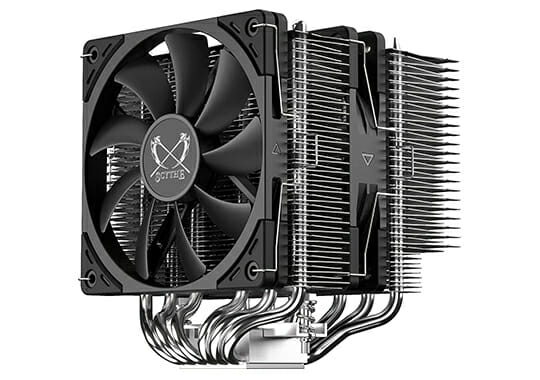
The original Scythe Fuma 2 has solidified itself as a great air cooler on the market for a while now so you might think it is bizarre that there would be a revision to an already great product but Rev. B is actually worth your time and here is why.
The Fuma 2 Rev. B has even better compatibility with motherboards that rock higher VRMs/RAM sticks by including a notch in the heatsink. Rev. B keeps the slimmer 14mm fan and 25mm standard fan configuration for the same compatibility reasons but swaps them for the new Kaze Flex II 120mm fans for better performance.
Kaze Flex II fans come with 50% more static pressure at a given RPM and also a higher RPM (1500 instead of 1200). The main reason this swap in fans was done was simply to increase the performance of the air cooler while maintaining the silent operation. The fans also spin in opposite directions to increase static pressure which should theoretically help them cool the heatsink even faster.
So is the Scythe Fuma 2 Rev. B better than the original version? YES! The Fuma 2 Rev. B still has the amazing HPMS mounting system, has incredible compatibility with most motherboards, has increased performance due to new fans, and is as expected a better, more refined product.
- Amazing air cooler when the price to performance is factored in
- Has a great mounting system
- The Rev. B comes with better fans that have a higher RPM
- One of the quietest CPU coolers
- The Rev. B is a bit more expensive (officially the price increased by 6$ but it might depend on the market you are in)
NZXT Kraken X73 RGB
The Best High-End RGB AIO CPU Cooler
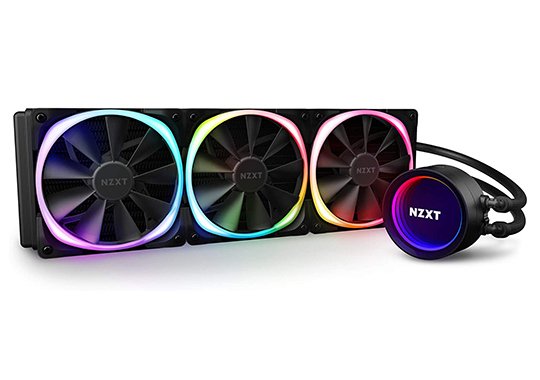
- Radiator Length: 360mm
- Number Of Fans: 3x120mm Aer RGB 2 (500-1500 RPM)
- Dimensions: 121 x 394 x 27mm
The NZXT Kraken X73 is a capable AIO suitable for literally any CPU on the market but one glaring issue with it is a pretty loud noise when under load. The RGB version of the model (surprisingly) solves the noise issue, making the Kraken X73 RGB one of the best RGB AIO solutions around.
The new AER RGB 2 fans have slightly weaker thermal performance compared to the Aer P fans found on the regular X73 but their noise levels are in line with some of the quietest AIO coolers we’ve seen. Not only that the new fans are quieter, but they also look amazing. Unique NZXT fin design combined with bright and colorful LEDs equals top of the line RGB experience, further improved with the RGB CPU block that also features a fantastic mirror effect.
The NZXT Kraken X73 is one of the best AIO coolers you can get, but it’s far from being the best bang for the buck. The selling price is quite high but if you want a stunning RGB AIO that packs serious performance while being silent even under extreme loads, this is the one to get.
- Impressive Performance
- Extremely Quiet
- Impressive RGB Experience
- Slick Design
- Pricey
ID-COOLING IS-55
The Low Profile King of Value
- Low profile fan at only 55mm height
- 120×120×15mm PWM fan
- Addressable RGB lighting
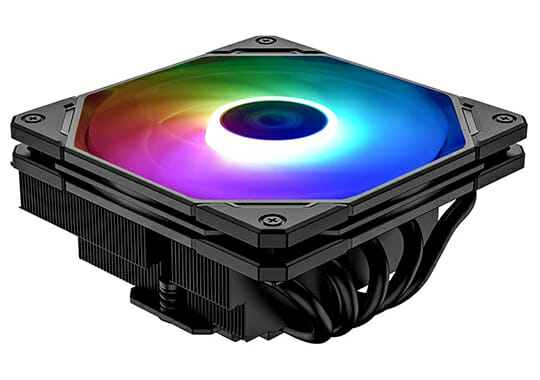
The ID-COOLING IS-55 is one of the best (if not the best) low-profile CPU coolers you can buy on the market currently. This might be a bold statement to make considering how big the competition is but there are a couple of solid reasons for this choice of words.
The main reason is the fact that this CPU cooler performs extremely well and delivers the best temperature (while noise-normalized) while costing only a fraction of the possible competition. The only other low-profile fan that got close to the IS-55 is the Noctua L12 Ghost which is a lot more expensive (IS-55 @ 40 $ vs L-12 @ 55$).
The IS-55 is excellent for small form factor builds since it is only 55mm tall and it uses a slim 120mm (15mm tall) PWM fan that can reach 2000 RPM. The IS-55 can be used both with Intel and AMD sockets since it has excellent mounting hardware.
The IS-55 also has ARGB lighting which adds value to the overall package at hand. The only real issue you need to be aware of is the fact that the heatsink design limits RAM height to 33mm. This means you need to use barebone RAM sticks or some other extremely low-profile option. In certain cases, you can flip the cooler around if your I/O is not super high and fix this issue that way but this will work purely depending on the motherboard you have.
- Best performance when it comes to low-profile CPU coolers
- Best value low profile CPU cooler as well
- Works with both AMD and Intel platforms
- The RGB is great for the bling lovers
- Limited RAM height space
Corsair iCUE H150i Elite Capellix Liquid CPU Cooler
Excellent High-End RGB AIO
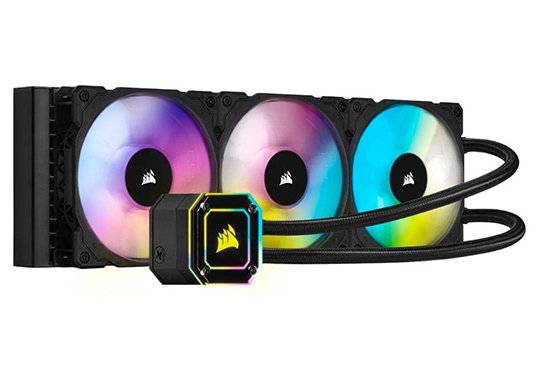
- Radiator Length: 360mm
- Number Of Fans: 3 x 120mm ML RGB (500 – 2400 RPM)
- Dimensions: 397mm x 120mm x 27mm
The iCUE H150i Elite Capellix is the latest premium AIO cooler from Corsair and while pretty expensive, it offers superb performance and a rich RGB experience. First of all, let’s talk about design. The ML RGB Fans used here are quiet most of the time while featuring four very bright and colorful LEDs on each fan. The end result isn’t the best RGB implementation we’ve seen but it’s still very attractive.
When it comes to performance the iCUE H150i Elite Capellix is one of the most potent 360mm AIOs you can get. It can match other high-end AIOs, RGB or not while at the same time providing pretty low noise levels. Now, if fans are set close to or at 100 percent, they become annoyingly loud. Luckily, this will hardly happen in real-life since you can easily set them at lower RPM which’s still good enough even for a heavily OCed 10900K.
Last but not least, is the fact that the AIO comes with the RGB fan control and that the iCUE software works pretty well, offering a ton of RGB effects and customizations. Overall, the iCUE H150i Elite Capellix is a quality product. It packs virtually the same performance as its predecessor, the H150i Pro RGB, and sells at a similar price. That means it is quite pricey but worth the money if you’re into RGB.
- Excellent RGB Effects
- Great Performance
- Perfect For Overclocking
- Can Work With Any CPU On The Market
- Very Noisy When Fans Work At 100% RPM
- Pricey
Cooler Master MasterLiquid ML360 Mirror ARGB
Quiet RGB AIO Cooler With Competitive Price
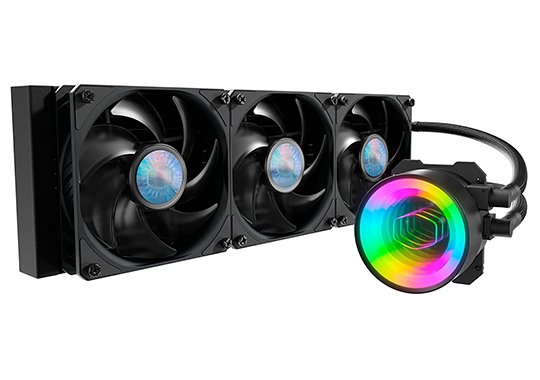
- Radiator Length: 360mm
- Number Of Fans: 3 x 120mm SickleFlow Fans (650 – 1800 RPM)
- Dimensions: 394 x 119.6 x 27.2 mm
The MasterLiquid ML360 Mirror from Cooler Master is one of the best choices for users who want a bit of RGB but don’t want to have a rave party inside their case. The AIO comes without RGB fans but it does feature an RGB CPU block with a fantastic mirror effect. Aside from the CPU block, the MasterLiquid ML360 Mirror doesn’t have any extravagant details, featuring a utilitarian design.
As for the performance, this is a capable 360mm AIO that won’t break any record but will be more than enough even for something like the 10900K. Aside from pretty solid performance, you can also expect very low noise levels, even under heavy loads. Overall, the MasterLiquid ML360 Mirror offers great performance while being extremely quiet and having subtle but very attractive RGB Implementation.
- Solid Performance
- Impressive RGB Mirror Effect On The CPU Block
- Very Quiet Even Under Heavy Loads
- Competitive Price
- Doesn’t Feature RGB Fans (Subjective)
Thermaltake Water 3.0 ARGB
Powerful Cooler With Synchronized Lighting Effects
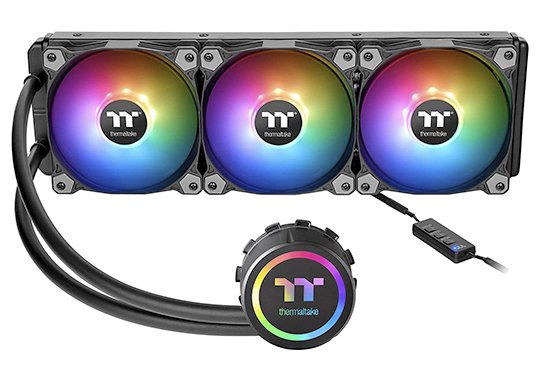
- LED Lights on Pump and Fans
- Large High-Efficiency Radiator
- Reinforced Sleeve
The Thermaltake Water 3.0 is an advanced liquid cooling system for Intel and AMD CPUs. It can cool down demanding CPUs, with great support for overclocked devices. It also features LED rings on the pump and radiator fans.
The LEDs on all areas of this CPU cooler give you great options for synchronizing the effects. You have a choice of 16.8 million colors, which can blend in with just about any color scheme.
The cooling system has a large radiator surface to deal with overclocked devices and reinforced tubing to cut down on evaporation. This is one of the best AIO CPU coolers for avoiding maintenance that comes with liquid cooling.
- Low Evaporation
- Can Deal with Heat Bursts
- Some Issues with Pump
Arctic Liquid Freezer II 420mm
The Biggest AIO You Can Find
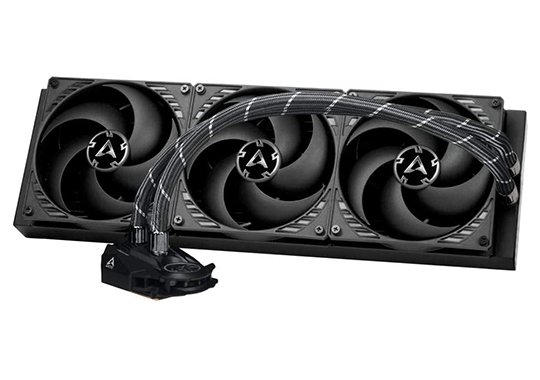
- Radiator Length: 420mm
- Number Of Fans: 3 x 140mm Arctic P14 PWM (200-1700 RPM)
- Dimensions: 458 x 138 x 38 mm
If you have a monster of a case and want the biggest AIO system available on the market, get the Arctic Liquid Freezer II, the 420mm version. But even if you don’t need the biggest AIO around, check out the Arctic Liquid Freezer II lineup because these AIOs are the best bang for the buck picks on the market. Unless you need RGB because you won’t find it here.
Logically, considering its size, the Arctic Liquid Freezer II 420mm is made for users who either want the ultimate performance or ultimate silence. This 420mm behemoth can do both at the same time. First of all, the massive radiator area can cool off even the hottest CPUs of today (think heavily OCed 10900K or the 5950X) while staying virtually inaudible.
Do note that you should definitely do a double-check whether this cooler will fit into your case. Not only because of its massive length but also because Arctic Liquid Freezer II AIOs have pretty thick radiators. Overall, this is a beastly cooler that offers maximum performance with zero noise. Best of all, it’s cheaper than many 360mm AIOs.
- The Best Performance On The Market
- Inaudible Even Under Heavy Loads
- Cheaper Than Most 360mm AIOs
- Great For Overclocking
- Won’t Fit Into Many Cases
How to Choose a CPU Cooler
Those are the best CPU coolers on the market at the moment. However, each PC and user is different. Your choice is going to depend on what your exact needs are. This buying guide covers everything you need to know to find the perfect cooler for your CPU.
What You Need to Know
Building a PC can be complicated. When it comes to CPU coolers, there are a lot of things you need to know. Between fan speeds, type of coolers, and even compatibility, it helps to know what you’re looking for. This is what you should know:
- Water or Air? – This is a big question. Water coolers tend to be more powerful but air ones are cheaper and often more reliable.
- Fan Speeds – The fan speeds given are in RPM or rotations per minute. This indicates how fast the fans will run at any given time, this applies to both air-cooled systems and liquid cooling. This affects the volume of your fan.
- Compatibility – The vast majority of CPU coolers are compatible with most CPUs since all they’re doing is extracting heat. However, mounting is more complicated if the cooler isn’t specifically made for that shape or model of CPU. It is worthwhile double-checking that all your components align before purchasing.
- Overclocking and Cooling – If you’re using an overclocked CPU, your cooling needs are different. Overclocked CPUs have the potential to run significantly hotter than they should be running, so you’ll need a more powerful cooler.
- Thermal Paste – You use this to attach a heat-absorbing area to your CPU, it can increase the effectiveness of your set-up, so consider buying some thermal paste.
What You Need to Consider
There are so many options for CPU coolers, that it can be difficult to know where to start. You have to consider what your needs are, then you can find a CPU that fits your requirements. These are the things you should figure out and consider:
- What Noise Level Can You Tolerate? – Quieter is better, at least for most people. However, there is a trade-off in price. If you can tolerate a louder cooling system for the sake of price and efficiency, then you should consider going for a cheaper and louder model.
- Energy Needs – Some CPU coolers are more energy efficient in their cooling than others. The majority are going to decreases your energy consumption by making your CPU more efficient. Lighting and other cosmetics can increase the drain though.
- Cosmetics – A lot of CPU coolers come with programmable LED lights. While a nice extra, it is worth considering if you need these.
- Ease of Installation – Some CPU coolers can be particularly difficult to mount and some are very simple to attach. Make sure you know what you’re getting yourself in for with installation.
Liquid Cooling Vs Air Cooling
The best CPU coolers can be divided into two categories; liquid coolers and air coolers. This can be a bit confusing to those completely new to building a PC. This is what you need to know about the two.
Air Coolers
Air cooling is pretty much the default for the coolers you’ll find pre-installed on devices. These use fans to expel hot air out from your system, PCs normally have some in the front and back.
The main reason for using air coolers is they’re considerably cheaper than liquid cooling. They get the job done, and they do it for less money, they’re also pretty easy to install and set-up, plus they require little maintenance.
The downside of fans is that they aren’t anywhere near as efficient. This can become a problem if you’re building an overclocked monster of a PC. If you’re building your own gaming PC, chances are you’re dreaming a little bit of an overclocked monster of a machine, so air cooling has some flaws.
Liquid Cooling
Liquid Cooling works by attaching a water block or radiator to your CPU. This absorbs the heat which is expelled through the water. This method can be difficult to set-up, which is why many people now opt to purchase an AIO CPU cooler rather than set one up with components themselves.
Water cooling has the benefit of being considerably more energy-efficient, much quieter, and being able to handle higher temperatures. However, there are some drawbacks.
The first is the price. Liquid coolers are quite a bit more expensive since they’re a more elaborate set-up. They are also hard to install and require more maintenance. A lot of people think this is a fair trade-off for the increased efficiency though.
Either cooling system can work well in a gaming PC. Which one is right for you just depends on your priorities.