
The Best Wi-Fi Routers for Long Range in 2024

If you have a large home, finding a router that can provide full coverage in every part of the house can be a journey filled with frustration and disappointment. Luckily, we’ve picked the best wi-fi routers for long-range, which are designed to offer an excellent range and great performance at long range. It’s one thing getting a wireless signal afar from your router. It’s another thing having a usable signal. A signal that’s fast enough to play games or watch videos.
Most of these routers are pretty expensive but if you want the best long-range router get ready to pay the price. These aren’t USB Wi-Fi adapters, with a limited set of features and small enough to fit in the palm of your hand.
We’ve also included one mesh router system that’s great for expanding range in case you expand your house or move to a larger house or apartment. Instead of having to buy a brand-new router just add another mesh node and get the signal to where you need it.
Below you’ll find the best long-range routers on the market. There are plenty of different models that offer a wide range of features. You have a selection of Wi-Fi 6 long-range routers, routers that are designed for gamers, along with the aforementioned mesh Wi-Fi system. And once you finish with the list you can read out long-range router buying guide that can be find at the end of this article.
Best Wi-Fi Routers for Long Range
NETGEAR Nighthawk AX12
Excellent Long Range Router That’s Rather Expensive
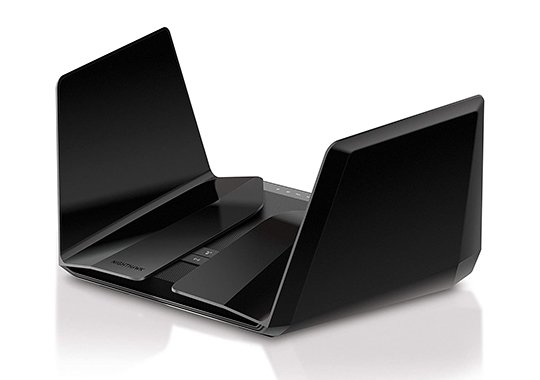
- Dual-Band Support
- Wi-Fi Support: 802.11a/b/g/n/ac/ax (Wi-Fi 1-6)
- Number Of Lan Ports: 4 x 1Gbps + 1 x 5Gbps LAN Ports
- Max Bandwidth: 1200Mbps on 2.4GHz; 4800Mbps on 5GHz
The NETGEAR Nighthawk AX12 is an impressive-looking router. The futuristic design is backed up with a remarkable range of features but also with an extremely high price. For the price, you get pretty solid performance. The router is rated at 1200 Mbps for the 2.4GHz band and up to 4800 Mbps for the 5GHz band. The advertised range is 3500sq feet.
Real-life tests show striking numbers, at least for the 5GHz band. The 2.4GHz band shows very good performance but not best in the category, which was expected due to the high price. The router supports all of the regular tech that should improve the speed for receiving devices such as beamforming and MU-MIMO.
It also supports Wi-Fi 6 standard so if you have a newer smartphone or laptop you should get increased speed when using those. Finally, the Nighthawk AX12 can support a huge number of devices hooked to the network at the same time so it’s great for households where there are dozens of wireless devices that are always connected to the network.
The router is powered by a quad-core CPU and it offers four Gigabit LAN ports on the back along with one 5Gb LAN port, which is pretty solid. But for this price, we would like to see more multigigabit LAN ports. The back of the router also hides a WAN port along with two USB 3.0 ports. Aside from average 2.4GHz performance, the Nighthawk AX12 is very pricey and it lacks advanced parental controls.
- Excellent 5GHz Performance
- Lots Of Extra Features
- Excellent Design
- Solid Range
- Expensive
- Average 2.4GHz Performance
- Only One Multigigabit LAN Port
ASUS ROG Rapture GT-AXE11000
ROG Stands for Overkill WiFi
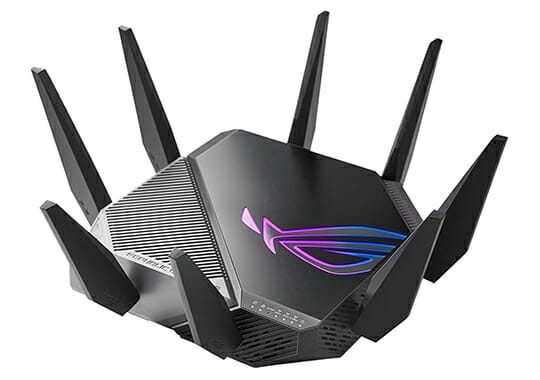
- Wi-Fi 6E gaming router
- Up to 11Gbps speed
- 2.5G WAN/LAN Port
- Dedicated 6GHz band
- Dedicated CPU and cooling capability
Most ROG products are known for being overkill and the ASUS ROG Rapture Wi-Fi 6E router fits in that category perfectly. This tri-band router can give you speeds up to 11Gbps which is so fast that most computers can’t use it unless paired with a specialized motherboard and network card.
The Wi-Fi 6E standard allows the router to use a new 6GHz band that is entirely dedicated to Wi-Fi 6E devices which means older devices cannot interfere with the work of your router. To achieve the full speed of Wi-Fi 6E you need to use the 2.5 WAN/LAN port that will be given priority over all other ports.
The router uses a 1.8GHz 64-bit Quad-Core CPU with 1GB RAM allowing parallel processing for increased speed when handling data. Since the GT-AXE11000 can run hot because of how fast the components need to run, the device has been designed with special vents, heatsinks, and thermal pads for optimal cooling.
The device has triple-level game acceleration and allows you to run both a gaming and a VPN connection at the same time. The ROG Rapture also uses AiProtection Pro that has automatic, regularly updated security signatures to protect your devices and personal data from internet threats.
Overall this is an incredibly complex device that can achieve amazing performance with a plethora of features that will enhance any gaming experience.
- Overkill for most networks that people have at home
- Extremely fast and stable Wi-Fi and LAN connections
- Advanced software capabilities like running a normal and a VPN connection simultaneously
- Has RGB 🙂
- 600$ for a networking device seems a bit crazy
- Gigabit connections are slowly making their way into people’s houses but 10Gbps connections are extremely rare
- Requires special motherboards with special networking cards that support 10Gbps networks
TP-Link Archer GX90
Red Means Fast Right?
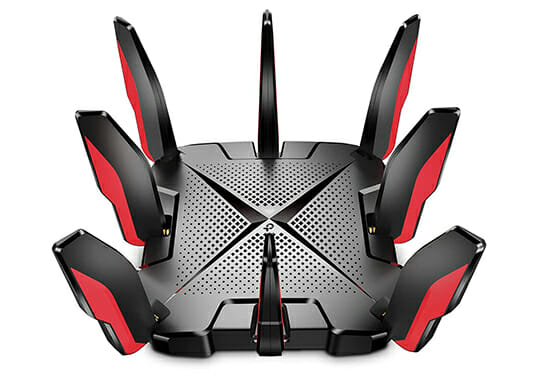
- Wi-Fi 6 gaming router
- 4804 Mbps 5GHz gaming band
- 2.5 Gbps ethernet port
- Up to 100 devices connected
- Dedicated CPU for maximum performance
The TP-Link Archer GX90 is a Wi-Fi 6 router designed specifically with gaming in mind and that can be seen both when looking at the capability of the device and its design. The TP-Link Archer GX90 uses a special tri-band structure that provides 4.8 Gbps exclusively for your gaming devices. This is done through the special 5GHz gaming band that is separate from the normal 5GHz band.
The regular 5GHz band runs at 1201 Mbps and the 2.4GHz band runs at 574Mbps. Even though the lower numbers do not look that impressive you must remember that most households have a basic 100 Mbps setup and this router can push 5x times that on a 2.4GHz connection.
The connectivity of the device is also impressive with a solid 1 × 2.5 Gbps WAN/LAN port + 1 × 1 Gbps WAN/LAN port + 3 × Gigabit LAN ports and 2 x USB ports. This will allow you to connect the fastest possible devices with an Ethernet cable and achieve 2.5 Gbps speeds for gaming. The cool part about this device is that you can connect up to 100 devices to the router because of OFDMA and MU-MIMO technology that delivers data to multiple devices at the same time.
To ensure that your network is running at top speeds at all times this gaming router also includes a 1.5 GHz Quad-Core CPU. All of these features come at a price but if you value the stability of your network over anything else this is a perfect router for you.
- Blazing fast speeds for all sorts of devices
- Stable Wi-Fi connection through the gaming band
- 8 detachable antennas help you cover your entire house
- Great connectivity
- Expensive device
- To fully use the capability of this router you need to have a 2.5 Gbps internet connection
ASUS RT-AX3000 Dual Band WiFi Router
The Best Long-Range Router For Users Who Already Own ASUS Routers
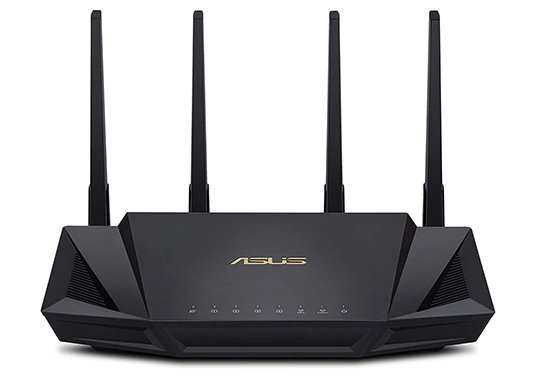
- Dual-Band Support
- Wi-Fi Support: 802.11a/b/g/n/ac/ax (Wi-Fi 1-6)
- Number Of Lan Ports: 4 x 1Gbps LAN Ports
- Max Bandwidth: 575Mbps on 2.4GHz; 2400Mbps on 5GHz
If you live in a large house or apartment, covering the whole area with a stable wireless signal can be a proper pain if you’re using a single router. One solution for this issue is to get a mesh Wi-Fi system but those can be quite expensive. The second option, offered by ASUS, is to connect two regular routers and cover the whole house with the ASUS AirMesh.
So, if you own an older ASUS router found on this list, pair it with the ASUS RT-AX3000 and get a mesh Wi-Fi coverage for less money. On itself, the RT-AX3000 is a capable Wi-Fi 6 router and one of the best choices in the mid-range market. It features Wi-Fi 6 support as well as various extra features that should improve signal strength and reliability such as OFDMA, beamforming, MU-MIMO, and, of course, ASUS AirMesh.
You also get excellent parental control implementation, four gigabit LAN ports, advanced security features, USB 3.0 port, Alexa integration, adaptive QoS, VPN, etc. When it comes to performance the router performs excellent via both bands. Even with multiple walls behind it and a wireless device, the signal stays strong and reliable. Overall, this is an excellent router selling at a very attractive price.
- Slick Design
- Great As A Base For ASUS AirMesh System
- Excellent Signal Quality
- Lots Of Extra Features
- Wi-Fi 6 Support
- Zero Major Downsides
TP-Link Archer AX90
8 Is a Good Number
- Triple-band Wi-Fi 6 router
- 4804 Mbps/5GHz
- 1201 Mbps/5GHz
- 574 Mbps/2.4 GHz
- 8 antennas
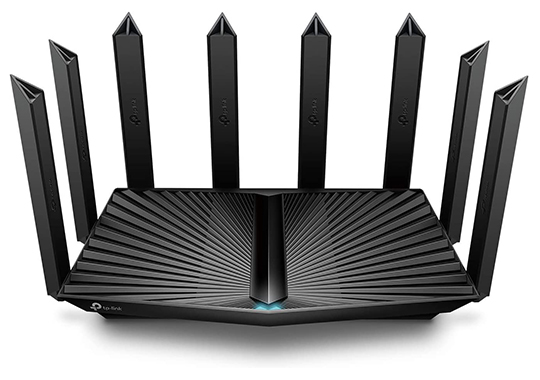
When looking for a long-range Wi-Fi router the number of antennas it has unironically correlates to a better experience on the network since it can cover more ground with a better signal. The Archer AX90 is a triple-band Wi-Fi 6 router that boasts 8 high-gain antennas that have Beamforming technology to maximize long-range coverage.
OFDMA and MU-MIMO tech also makes sure data can be delivered to multiple devices on the same network without signal degradation over time. Overall the Archer AX90 can do 4804 Mbps on 5 GHz, plus another 1201 Mbps on 5 GHz, and finally 574 Mbps on the standard 2.4 GHz band.
Combine all of this with 5 LAN ports and 2 USB ports, and a bunch of security features that come with TP-Link devices and you can see how having a router with 8 antennas might not be such a bad idea if you have a big house.
- Wi-Fi 6 and 8 antennas means stable coverage around a larger space
- Plenty of Ethernet ports for most households
- Beamforming, OFDMA, and MU-MIMO technology in one package
- The installation process might not be the smoothest or easiest out there
- The K5 is pretty decently sized so it is not exactly a portable device with that external power brick in tow
Google Wifi
The Best Budget Mesh Long-Range Router
- Dual-Band Support
- Wi-Fi Support: 802.11a/b/g/n/ac (Wi-Fi 1-5)
- Number Of Lan Ports: 1 x LAN Port Per Node
- Max Bandwidth: Combined 1200Mbps Over The 2.4GHz and 5GHz Bands
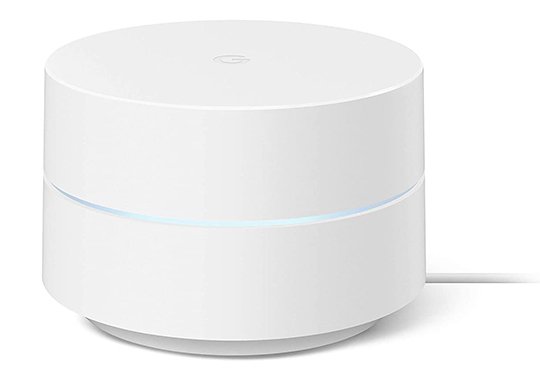
The original Google WiFi mesh system just got updated with a refreshed 2020 model. It doesn’t bring many improvements but the lower price combined with an excellent Google Assistant integration and solid specs make Google WiFi (2020) the best budget mesh Wi-Fi System. Each node can cover 1500 square feet and with the three-pack option you can cover up to 4500 square feet of space.
The router supports Wi-Fi 5 and its AC1200 spec means it can provide up to 1200Mbps over its two active bands (2.4GHz and 5GHz). Each Google WiFi node comes with a LAN port, which is great news for everyone in need of an affordable mesh system that can connect to wired devices.
The new Google WiFi can also be used as a cheap way to boost your Google Nest WiFi network thanks to the two devices’ cross-compatibility. Sure, it could’ve been faster and offer more features but that would mean increasing the price, which is the greatest strength of the Google WiFi mesh system.
- Affordable For A Mesh Wi-Fi System
- Great For Extra-Large Homes
- Solid Speed And Dual-Band Support
- Google Assistant Integration
- Compatible With Google Nest Wi-Fi Mesh System
- Could’ve Been A Bit Faster
- Shorter Coverage Per Node Compared To Google Nest Wi-Fi
How To Choose A Router For Long Range
The most important feature when looking for your new long-range router is, well, its range. That should be your primary point of concern. The good news is that most routers labeled as long-range routers include a wide set of extra features since they are usually on the more expensive side.
If you want to read a detailed router buying guide check out our routers under $100 list. It includes an in-depth buying guide where we discuss all important features to look for in a router. Below you’ll find a buying guide dealing with specific features to look for in a long-range router.
Don’t Take Router’s Advertised Wi-Fi Range For Granted
Many manufacturers advertise router’s range, but you shouldn’t take those numbers for granted. After you find a router with the desired range, check professional and user reviews to see whether the router is indeed capable of providing Wi-Fi signal through the whole household.
Also, remember that each house and apartment are unique so if some users claim that a router is capable of covering their household that doesn’t mean you’ll get the same results. The best way of testing the range of a router is to buy it and test it inside your home.
This is why we always recommend getting the router from a place that accepts free returns. That way you can return it and get your money back in case you end up dissatisfied with the range of the wireless signal.
And remember that, if you need a long-range wireless router, it’s best to skip modem router combo devices. These usually have poor range since they are made to fulfill the role of both a router and a modem, not to provide the best possible range and quality of the wireless signal.
Get A Long-Range Router That’s Compatible With Mesh Wi-Fi Systems And Range Extenders
Another important point in case you have a large home is to get a router that can get its range increased with range extenders and mesh Wi-Fi systems. Imagine you get a router that’s perfect in every way except that it cannot deliver the wireless signal in one room of your house. You’ve already found a perfect router for you so why replacing it when you can get an extender or one mesh node and bring the signal to the room without it?