
Storage Vs Memory – What You Need to Understand
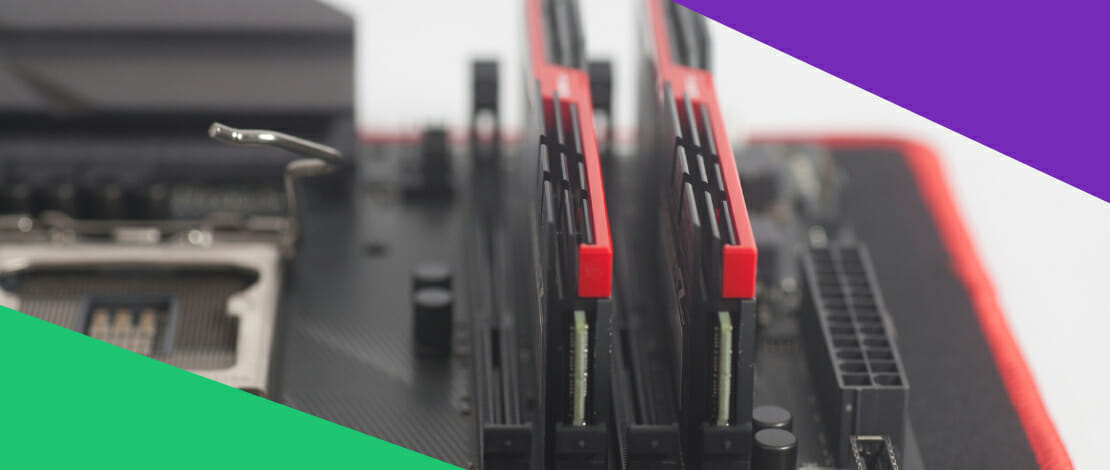
Computer terminology is confusing and when it comes to the terms that deal with storage and memory, it can get even worse. Memory is often used interchangeably with storage but it does not have to refer to the same thing.
Memory can be many things, but mostly it is divided into two groups, Volatile and Non-volatile. The former holds data for a short period of time and it is then lost, while the other can hold data even after it loses direct interaction with a process that is requesting the data. Storage is also a form of memory.
Since most of these things hardly make sense, here are detailed explanations of how storage and memory relate to one another as well as the many possible differences between the two.
Memory Vs Storage – The Basic Definitions
In computing, memory is divided into two groups, as mentioned above, Volatile and Non-volatile. An example of volatile memory includes RAM, meaning Random Access Memory, of which there is never enough when running Chrome tabs. RAM, or more specifically, DRAM in modern computers (D stands for Dynamic), loses data relatively quickly after it loses charge.
On the other hand, Non-volatile memory examples are ROM, meaning Read-only Memory, or flash memory. Flash memory is a type of storage, which is one of the reasons for the confusion between computer memory vs storage.
More Confusion
SSD Storage stands for solid-state drive storage and it can be confusing, typically because a default type of SSD storage that is used is flash memory. When we hear the word memory, we might want to confuse it with RAM or with VRAM (V stands for video).
However, in this case, flash memory refers to floating-gate memory, namely NOR and NAND flash, which uses MOSFETs, a type of transistor. This type of memory can be safely used for storage and can be found in most modern SSDs.
Modern SSDs, and even older SSDs, are much faster than HDDs, because they have no moving parts and require only a charge to be able to read and write data. An SSD is much faster than an HDD, up to 100 times, particularly when copying many smaller files.
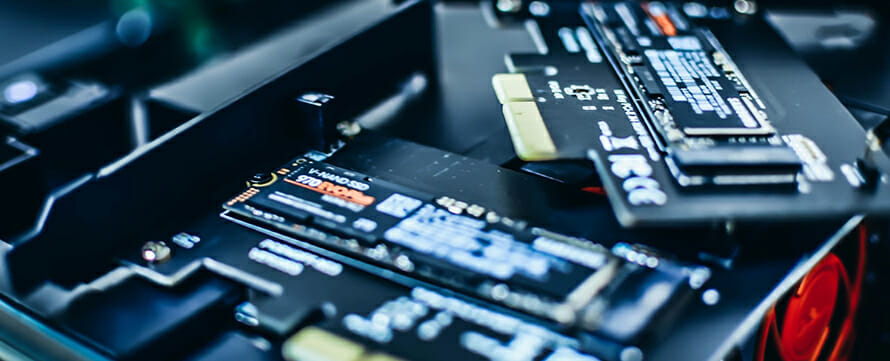
PCIe expansion cards with Samsung NVMe SSDs. Source: Marc Pezin
Memory, as we have learned, often stands for RAM or VRAM, depending on its use case. RAM is much faster than storage, so the computer uses it to store files that it is currently working on, for example, a video game. It will be loaded into your RAM, the parts that have to deal with the physics of the game.
The other part, which will eventually be loaded onto the screen, rendered, is stored in the VRAM. While in use, or while the game process is active, both the RAM and the VRAM will be storing data, so that both the CPU and GPU can access them quickly, performing tasks without latency. The faster the ram, the better it is for tasks like professional workloads. Faster RAM can also be better for gaming.
Faster RAM typically means less latency, which speeds up the communication between the RAM and the CPU. VRAM can also be tuned to increase its clock speed, thus somewhat affecting performance positively.
Laptop Memory Vs Storage – Is Laptop Memory Different?
In standard laptops and especially thin models, the type of RAM used is often LPDDR, which stands for Low-Power Double Data Rate. The low power part is important for mobile computers, because it helps save power when running on a battery, which is a typical use case scenario for laptops and smartphones.
Computers use NVMe drives while smartphones use UFS, the difference being the standardization. UFS stands for Universal Flash Storage. eUFS is present on most modern smartphones, and is not detachable, which is also known as internal memory.
Laptops can use NVMe SSDs, SATA SSDs and HDDs. Some laptops’ storage can be expanded with an HDD dock.
Storage Vs Memory Mac – What About Apple Computers?
Apple has always done things differently so do not be surprised to hear that they also sell their Mac computers with HDDs and SSDs with a twist.
The drives are regular, except their Fusion drives, which are a type of SSHD, or a hybrid of solid-state and hard drive. The main part of the drive is an HDD, but a smaller part, let’s say up to 64 or 128 GB of size is a flash memory drive.
The SSD part of the drive is used to store and quickly access some files which are frequently used. You can also move some files to the SSD part of the drive, making access to them faster.
Hybrid drives are not tied to Apple, only. Apple did name them Fusion, to differentiate them from the rest of the market. SSHDs have been around since 2007, and are made even today, by companies such as Toshiba, Seagate and Western Digital.
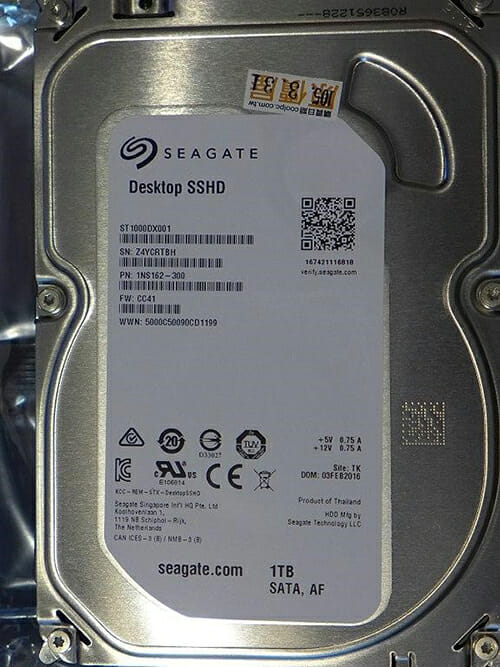
A 1TB SSHD from Seagate. Source: Kenming Wang
Summary
It is easy to forget that we refer to memory when talking about Random Access Memory, which is used to store data so that a processor can access it quickly, while also using memory to refer to flash memory, a type of storage, typically found in solid-state drives.
Storage, particularly solid-state storage, uses flash memory nowadays and can be confused with RAM, which is also used by all modern computers, from desktop to smartphones. To add more confusion, VRAM is another term which can get in between, but is used so that graphics cards can have their own discrete memory.
The semantics can be confusing, because we associate memory with both storage and RAM, but those are different things, namely non-volatile and volatile memory.
The difference is that the first does not lose data after it loses a charge, while the second does. One is used to store data and is slower and the other to hold data so that a CPU or GPU can access it faster.
This should clear up any confusions of the storage vs memory conundrum.